From the model to a priced BoQ automatically.
ProcureX BIM reads your design — IFC, Revit, DWG or PDF — classifies every element, measures it to IS 1200 (or any of 9 standards), and produces a tender-ready Bill of Quantities with a defensible, resource-built-up rate.
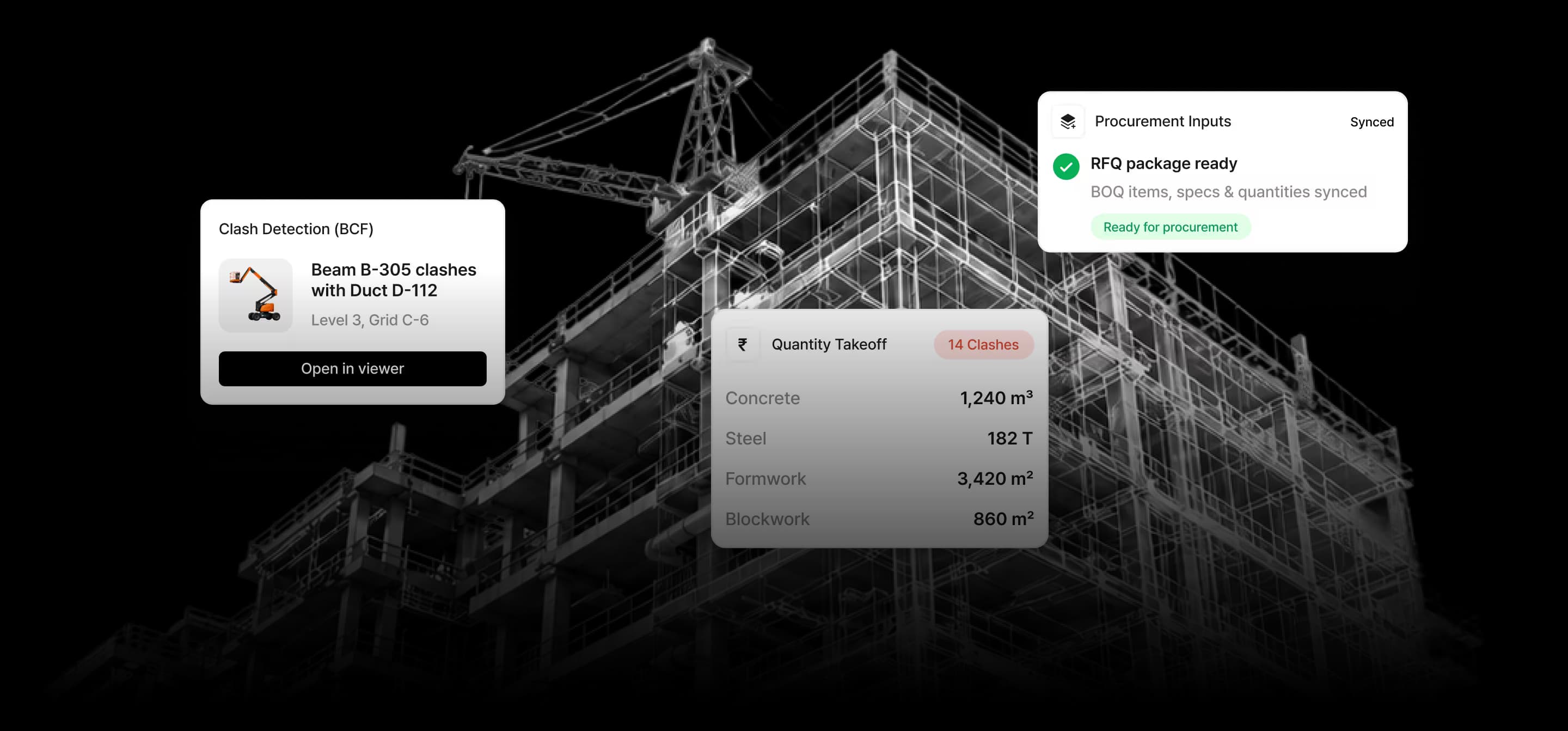
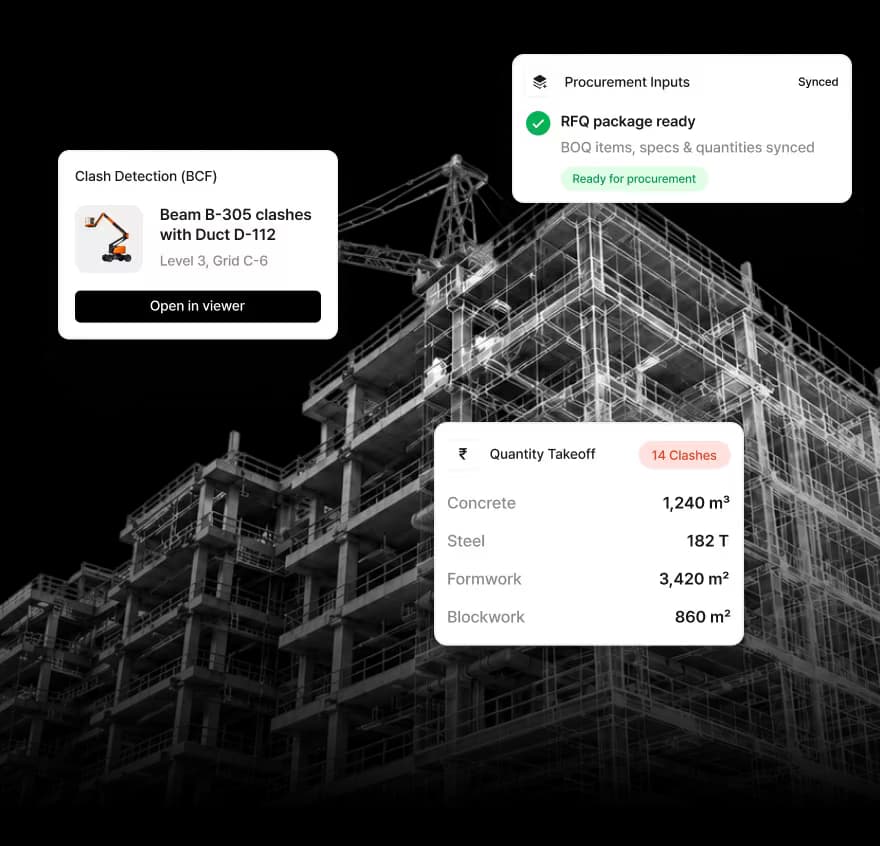
A BoQ That Speaks Your Site's Language
IS-code measurement, ₹ rates, GST in the bill and RA-ready lines — out of the box, not bolted on.
IS 1200 Measurement
BoQ grouped to the Indian standard, with net deductions applied.
CPWD DSR & State SoRs
Rates mapped to CPWD DSR and your state's schedule of rates.
Taxes & Multi-Currency
Taxes built into every bill and figures in your currency, the way your office reads them.
RA-Billing Ready
Line items structured for running-account billing from day one.
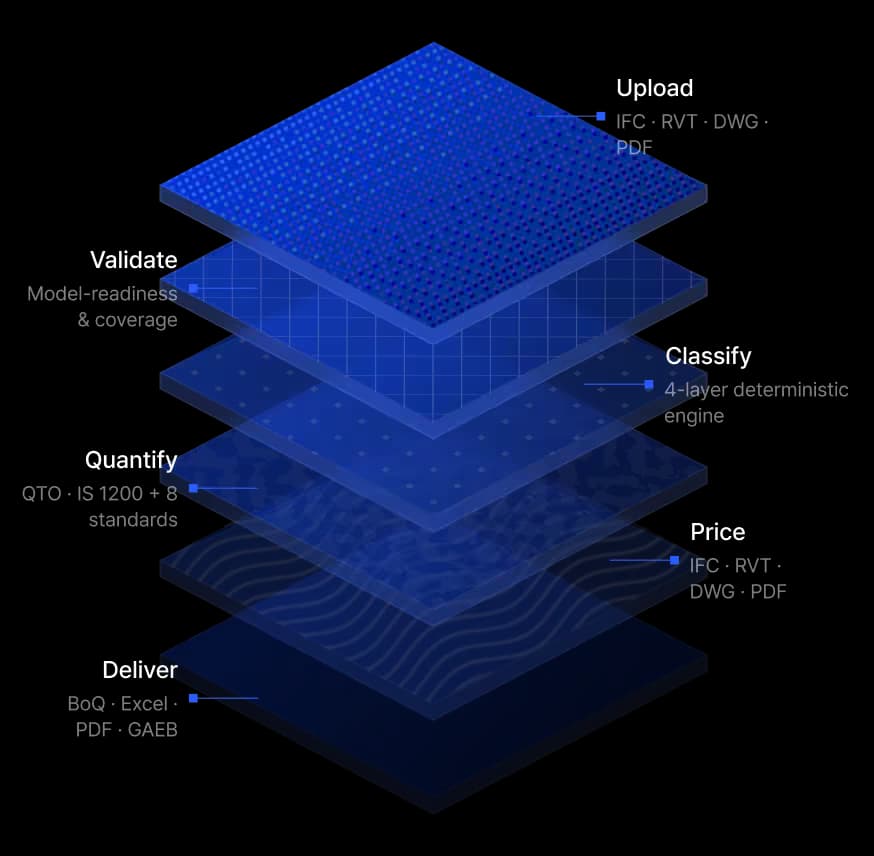
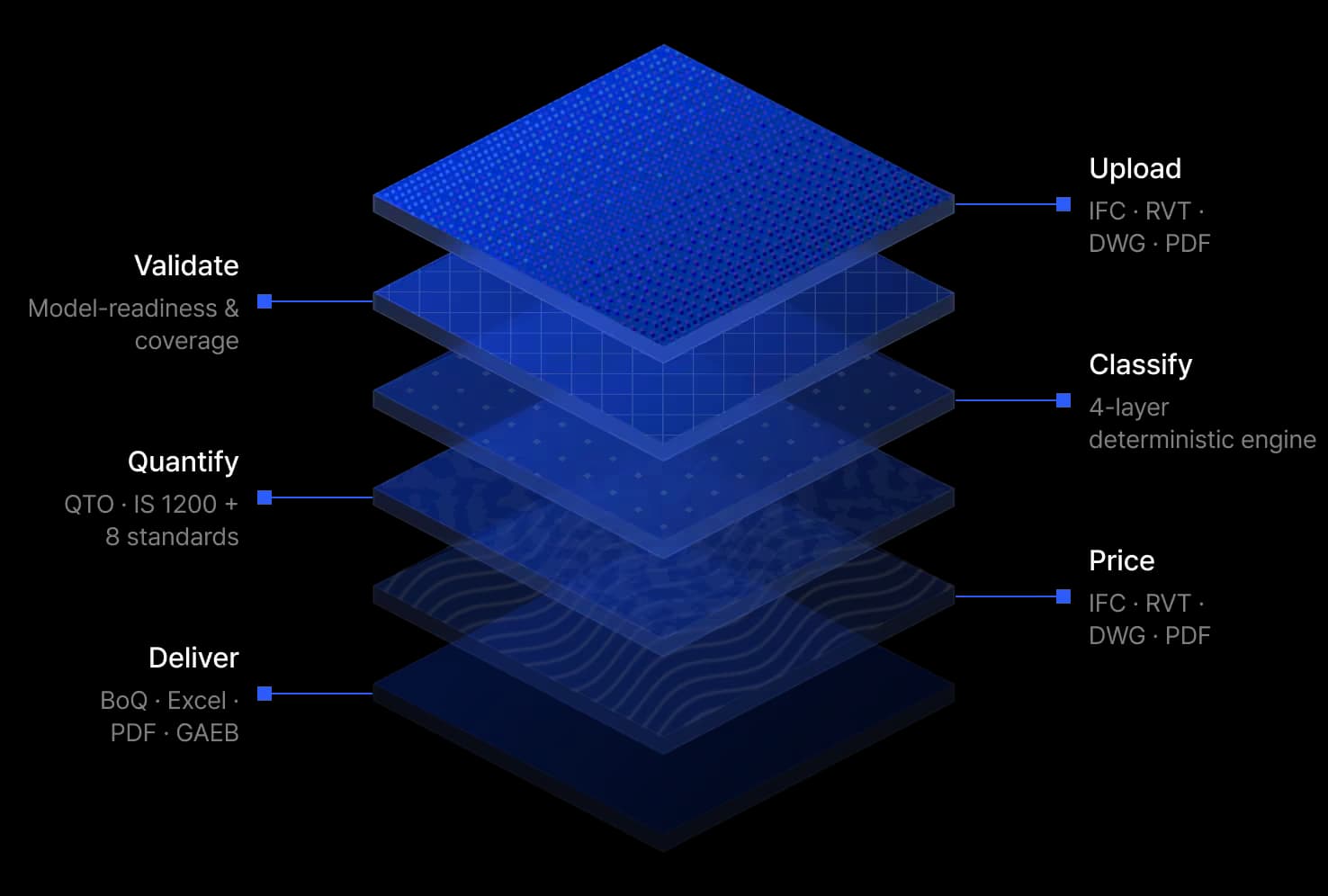
One Governed Pipeline, Model To BoQ.
Every project flows through the same pipeline — automatic end to end, with a human-in-the-loop checkpoint at each stage.
Weeks Of Manual Takeoff, Then A Rate Nobody Can Defend.
- Quantities are measured by hand off PDF drawings — weeks per tender, and never twice the same.
- When a drawing revises, the BoQ is re-measured from scratch — there's no link from a quantity back to the model.
- The unit rate is a black box in someone's Excel — hard to defend in a tender, a client review or arbitration.
- Projects still in 2D AutoCAD get left out of BIM entirely — the benefit never reaches them.
- Quantities are pulled straight from the model (or 2D drawings) to your chosen standard.
- A revised model re-runs in minutes — every quantity stays traced to its element.
- Every rate is built up from material, labour and plant — line-by-line, fully defensible.
- Works from IFC / Revit and from 2D DWG / PDF — the same priced BoQ either way.
Any Format, Any Maturity — One BoQ Out.
Your consultants deliver 3D models, 2D CAD and scanned PDFs — often on one project, and always changing. ProcureX takes all of it and returns the same auditable, IS 1200 BoQ.
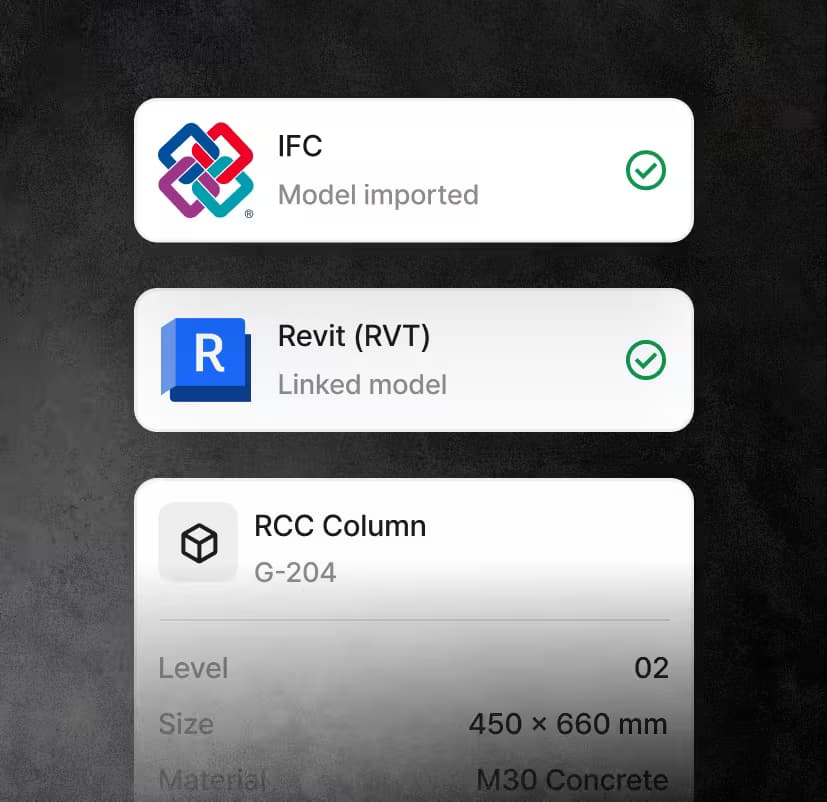
IFC & Revit (RVT)
Native IFC parsing extracts elements, geometry and properties directly from the model. Revit files convert to SVF2 for viewing and IFC for quantities — with element-level, traceable take-off and true BIM base quantities where present.
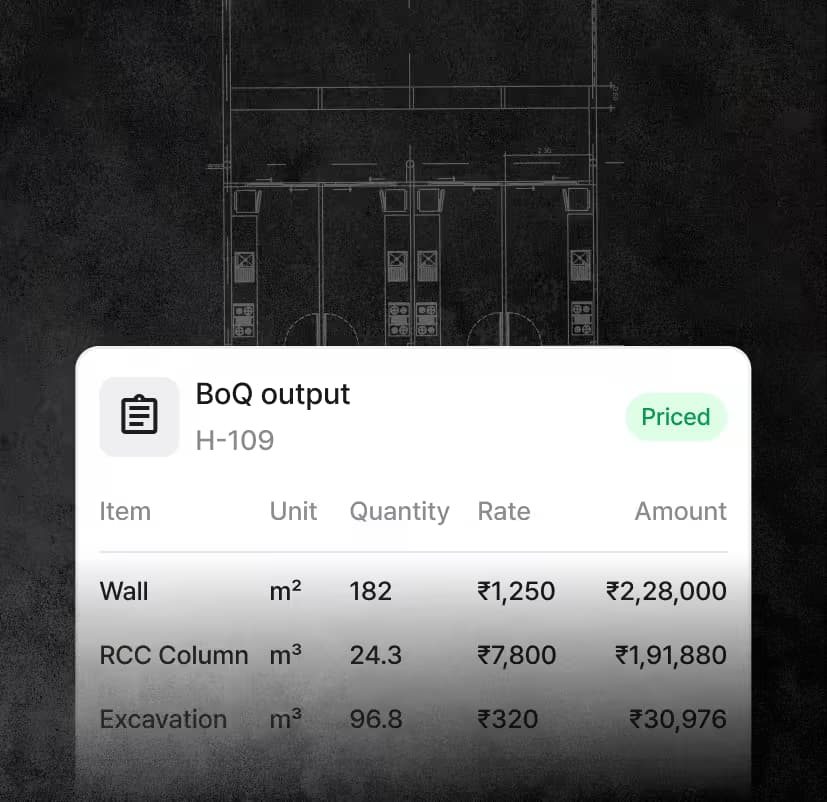
DWG & PDF Drawings
Not in 3D yet? 2D drawings are first-class — supported through layer-based classification and on-drawing take-off, producing the same priced-BoQ output as the 3D flow. Your 2D projects get the benefit too.
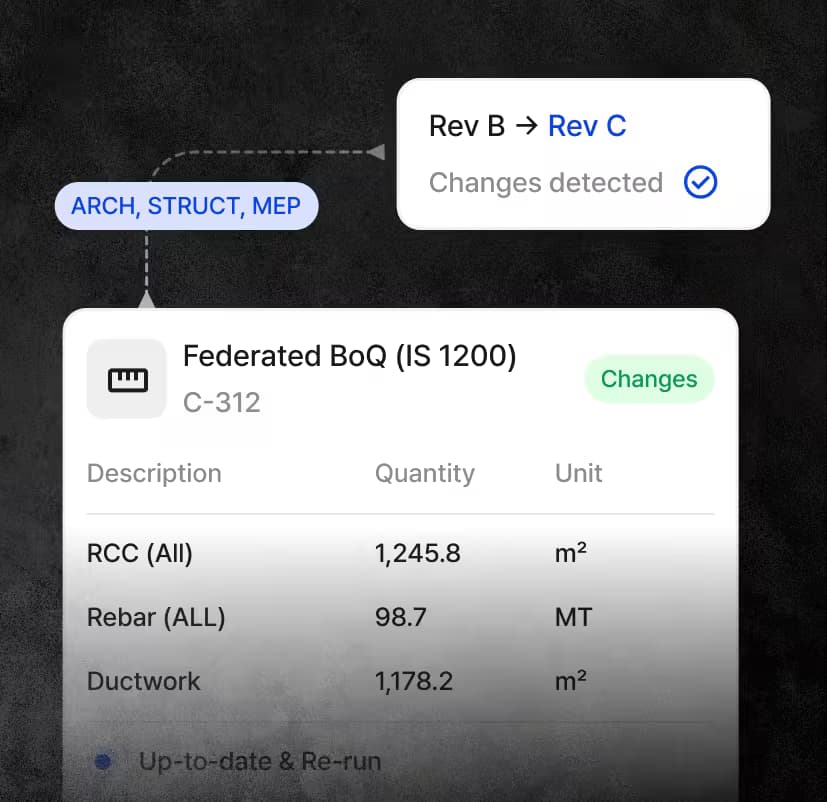
Federated & Revised Models
Combine multiple consultants' files — architectural, structural and MEP — into one takeoff, and re-run a revised model in minutes with every quantity still traced. The readiness gate scores incomplete models first, so you never price off bad data.
Deterministic Classification — No Guesswork.
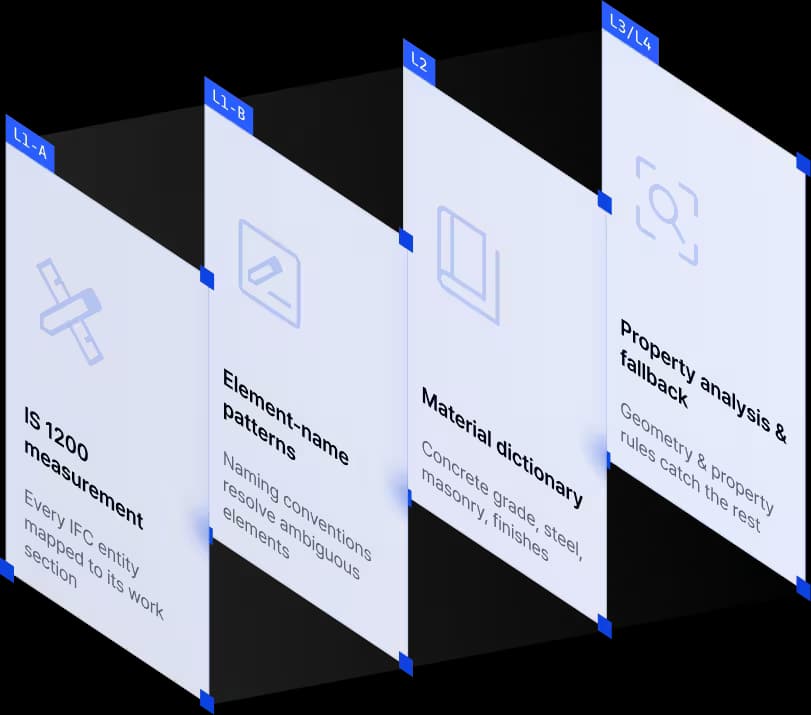
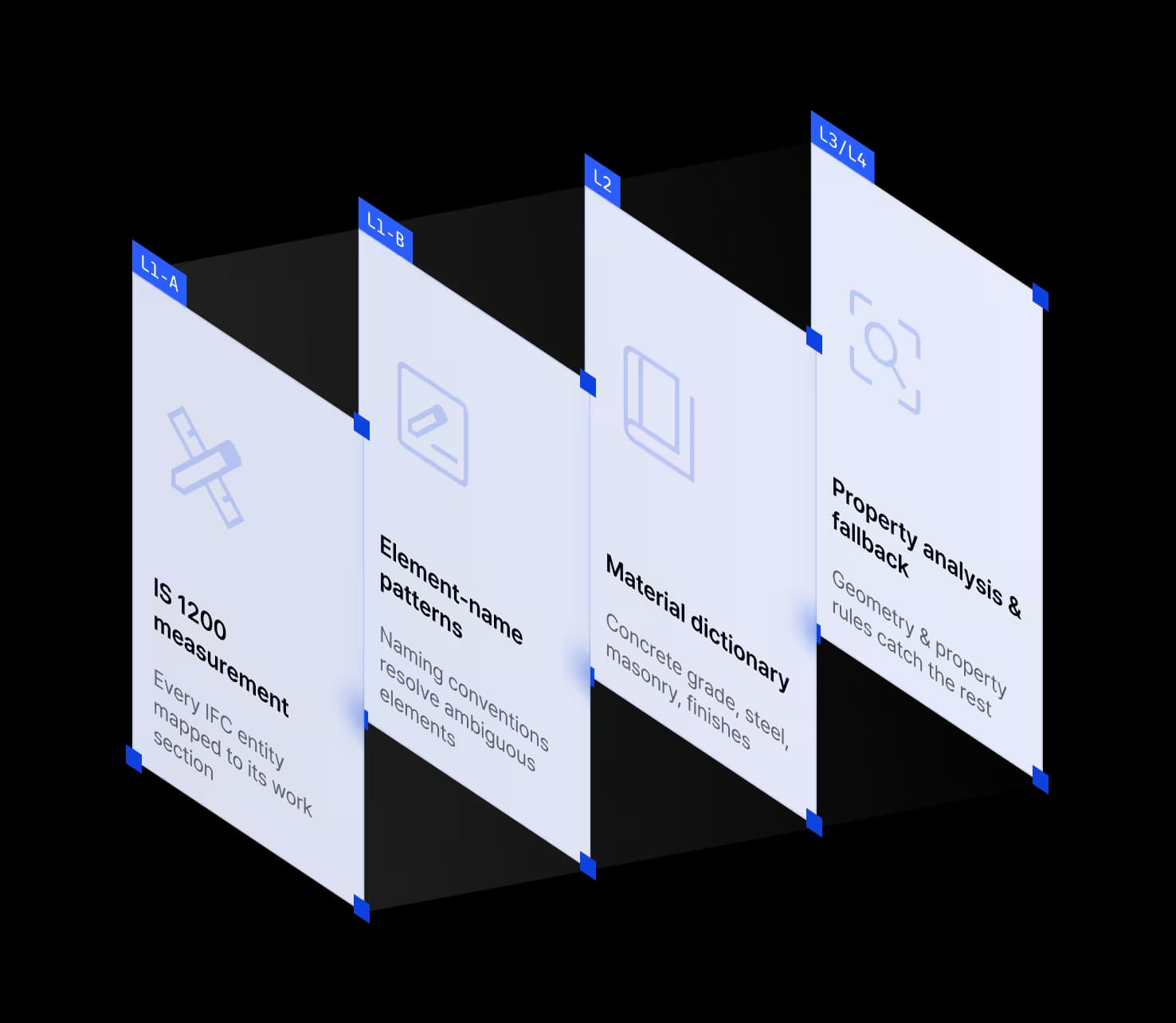
A Four-Layer Rule Engine — Every Result Auditable
Each element passes through four deterministic layers. No probabilistic guesswork: the same model always classifies the same way, and every result can be traced and explained — the way a QS or auditor needs.
- Net measurement rules per standard — opening deductions & wastage applied automatically.
- Pick the standard at project creation; the BoQ re-groups instantly — no re-work.
- Unclassified or zero-quantity elements are surfaced, never silently dropped.
Your Standard — IS 1200, And Eight More.
Group the BoQ under whichever published standard the project needs. India-first, with the global standards an Indian EPC needs to bid abroad.
| Standard | Authority | Region |
|---|---|---|
| IS 1200India | BIS | India — IS-code BoQ, the home standard |
| POMI | RICS | MENA / GCC · FIDIC contracts |
| NRM2 | RICS | United Kingdom |
| CESMM4 | ICE | Civil & infrastructure (GCC / UK) |
| CSI MasterFormat | CSI | United States / North America |
| UniFormat II | CSI | Elemental (US) |
| DIN 276 | DIN | Germany / Austria / Switzerland |
| SINAPI / TCPO | Caixa | Brazil / Latin America |
| GESN (ГЭСН) | Minstroy | Russia / CIS |
One engine, many markets. An Indian EPC bidding in the GCC gets POMI or CESMM out of the same model — no second tool, no re-measure
A Priced BoQ With A Defensible Rate.
Quantities come straight from the model; rates are built up from resources — so every line is justifiable in a tender.
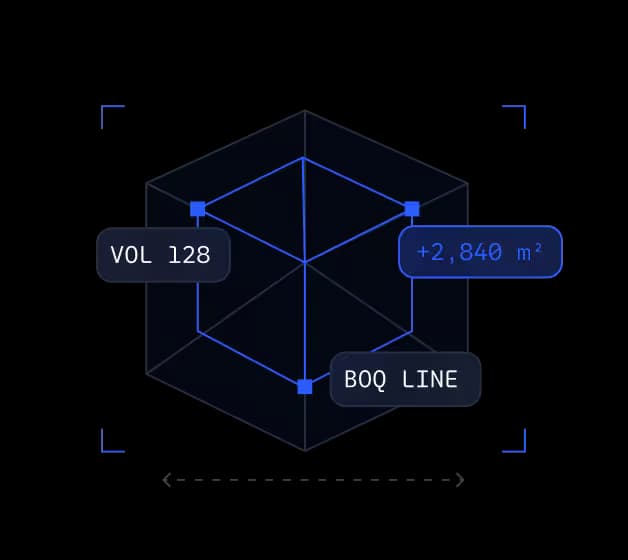
Automated quantity take-off
Volumes, areas, lengths and counts derived from BIM geometry and properties, then adjusted to net by the standard's measurement rules — with element-level drill-down on every line.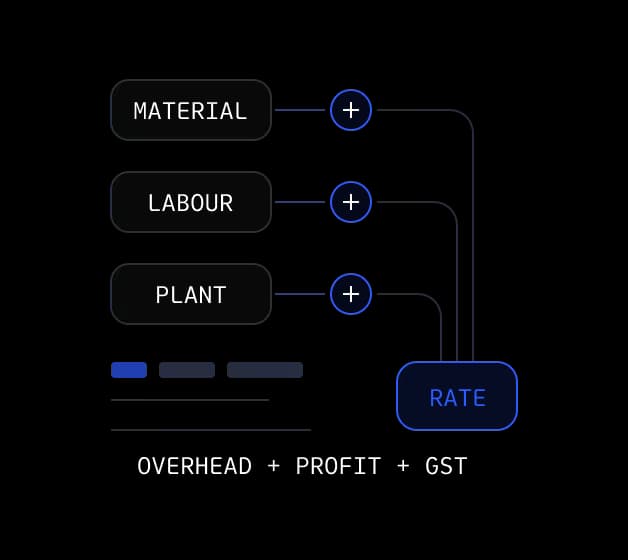
Resource-factor rate build-up
Analysis of rates: each unit rate is composed from resource quantities × current prices, split into material / labour / plant. Filter the whole BoQ by any of them, with overheads, profit, contingency & GST rolled up.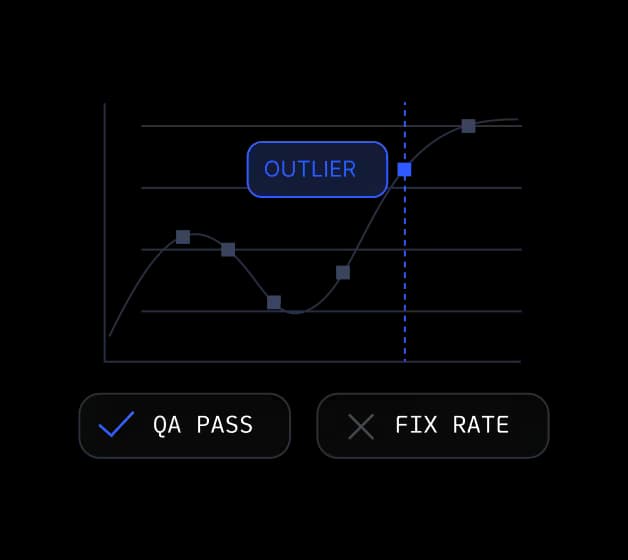
Cost intelligence & QA/QC
The engine suggests rates for unpriced lines and flags price anomalies and outliers before the BoQ is issued — so a mispriced line is caught while it's still cheap to fix.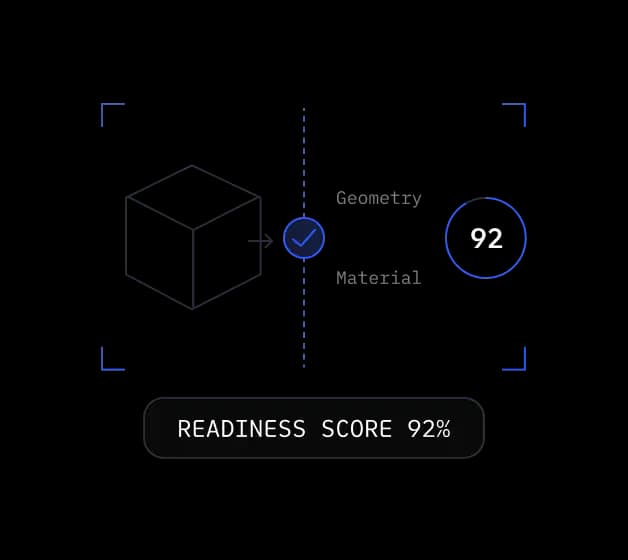
Model readiness gate
Before take-off, the model is scored for geometry and material completeness, and issues are surfaced pre-generation — so you never price off a poor model.A Governed Estimating Environment — Not A One-Shot Calculator.
- Coordinate
Model check & clashes
3D viewer and model validation, clash detection with issues tracked as BCF, plus AI quality checks before take-off.
- 3D Viewer
- Clash Detection
- BCF Issues
- Govern
Approval, versions & audit
Submit → approve → reject workflow, version snapshots and revision compare, and a full activity trail — with your editable rates preserved across re-runs.
- Approval Flow
- Revision Compare
- Audit Trail
- Deliver
Exports & interchange
Issue Excel and PDF bills, export CSV data, or hand off GAEB X83 for tender interchange — the BoQ leaves in the format the next step needs.
- Excel/PDF
- CSV
- GAEB X83
Global Defaults, Your Private Masters.
Shared global reference data every client inherits, plus private masters each organisation can override — productive on day one, with zero masters required to start.
Estimating masters — yours to own
Bring your own pricing and rules, or start on the global defaults and add them anytime.
- Rate library — bulk CSV / Excel import.
- Resource catalogue & assemblies (build-up)
- Materials & units of measure
- IFC classifications & QTO rules
8 region packs, out of the box
Pick a country and the project auto-fills the right currency, tax, measurement standard, work calendar and contract form.
- India
- MENA
- UK
- US
- DACH
- LATAM
- APAC
- CIS
India pack: ₹ currency, GST, IS 1200, Indian work calendar.



Your model is the sourceof truth — all the way tothe PO.
The BIM Quantity Validator, part of ProcureX IntelliSuite, checks vendor-quoted quantities against the model before any purchase order is raised — so over- and under-ordering surfaces before it becomes spend.


Both. ProcureX BIM parses IFC and Revit natively, and also takes off from 2D DWG and PDF drawings through layer-based classification and on-drawing measurement — producing the same priced BoQ either way. Projects that aren't in 3D yet still get the benefit.
Every quantity is traced back to a model element or drawing object, with the measurement rule applied shown on each line. Nothing is a black box — a QS or auditor can drill from any BoQ line to its source.
Yes. Rates can be mapped to CPWD DSR and state SoRs, or built up from your own resource library — material, labour and plant — with overheads, profit, contingency and GST rolled up.
IS 1200 is the default, with eight more global standards available. You can pick the standard at project creation and re-group the BoQ to another standard instantly — no re-measure, no re-work.
Inside ProcureX — encrypted, with role-based access. Global defaults are shared, while your private masters (rates, catalogues, classifications) stay scoped to your organisation and are never used to train public AI models.
BIM-to-BoQ is the automated flow from a building model to a priced Bill of Quantities — extracting quantities from the model, classifying them to a standard, and applying built-up rates, all in one governed pipeline.
5D BIM adds cost to the 3D model (the 4th dimension being time/schedule) — so quantities and rates are linked to model elements, and a revised model re-prices automatically with every quantity still traced.
IS 1200 is the Indian Standard method of measurement of building and civil engineering works — it defines how each item is measured and netted, so BoQs are consistent and contractually defensible.
Automated QTO derives volumes, areas, lengths and counts directly from BIM geometry and properties, then adjusts them to net per the standard's measurement rules — with element-level drill-down on every line.
Analysis of rates is the build-up of each unit rate from its resource components — quantities × current prices, split into material, labour and plant — so every rate is line-by-line and fully defensible.